Showing posts with label Paper 2. Show all posts

Saturday, 7 June 2014

6.20 know and use the relationship: input power = output power

VpIp = VsIs
For 100% efficiency

V = Voltage
I = Current
p = primary
s = secondary

To find one value rearrange the equation (i.e. divide by something on both sides to leave a value on the other)

(VpIp) ÷ Is  = Vs

Always use A for current, not kA 
Always use V for voltage, not kV

6.19 know and use the relationship between input (primary) and output (secondary) voltages and the turns ratio for a transformer.

V = Voltage
n = Number of turns
p = primary
s = secondary

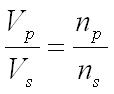
Input Voltage / Output Voltage = Number of turns of primary / number of turns on secondary

Always use volts and not kV

6.18 explain the use of step-up and step-down transformers in the large-scale generation and transmission of electrical energy

The voltage produced by power stations is too low to be transmitted efficiently. Power = VI (voltage x current) so for a given amount of power the current must be higher to accommodate for the lower voltage and current causes the wires to heat up. 

  1. A step up transformer is used to boost the voltage, thus lowering the current, before it's transmitted.
  2. Step down transformers are used at the end of the journey to lower the voltage to 230V and a much higher current. 

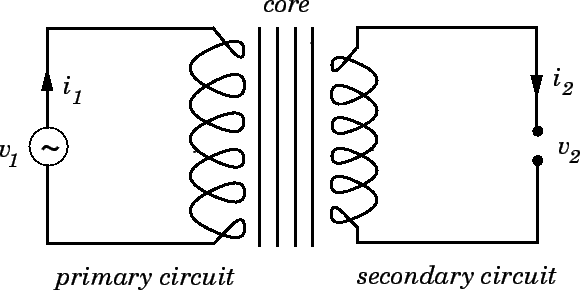
6.17 describe the structure of a transformer, and understand that a transformer changes the size of an alternating voltage by having different numbers of turns on the input and output sides

Transformer:
On the left we have the primary coil, then a soft iron core and then a secondary coil.

The job of the transformer is to change the size of the voltage of an alternating current.
They do this by having a different number of coils on the primary coil and secondary coil.

When an a.c. current is applied to the primary coil the soft iron core magnetises and demagnetises quickly. This induces a current an a.c. current in the secondary coil.

A step-up transformer has less coils on the primary coil than it does on the secondary so it steps up the voltage.
A step-down transformer has more coils on the primary coil than on the secondary so it steps down the voltage.

6.11 understand that there is a force on a charged particle when it moves in a magnetic field as long as its motion is not parallel to the field

When an electron, proton or any other charged particle moves through a magnetic field it experiences a force as long it's not moving parallel to the field lines.

6.9 describe the construction of electromagnets

A wire is wrapped around a soft core (usually iron). When this wire has a current flowing through it the core becomes magnetised thus making an electromagnet.

6.10 sketch and recognise magnetic field patterns for a straight wire, a flat circular coil and a solenoid when each is carrying a current


Magnetic Field Around A Straight Wire

Magnetic Field around a Flat Circular Coil

Magnetic Field around a Solenoid

Ignore the B= thing up top but do take note of where the current goes in and out represented by "I"

Using LHR in any question like this may be useful


6.5 understand that magnetism is induced in some materials when they are placed in a magnetic field

Some materials can become magnetically induced when placed near a magnet.
For example if steel is placed near a magnet then it can become a magnet.

The closer to the magnet the material is placed, the more the magnetism is induced.

The poles are created opposite so...
If you place a north pole of a bar magnet against a bar of steel then the end facing the north pole would become a south pole.

6.3 describe the properties of magnetically hard and soft materials

Magnetically hard materials are materials that stay magnetised after they have been exposed to a magnetic field. An example of this is steel.

A magnetically soft material is one that becomes demagnetised after it leaves a magnetic field. An example of this is iron. It's used in transformers as it can be magnetised and demagnetised many times a second.

6.2 understand that magnets repel and attract other magnets and attract magnetic substances

In a magnet:
Opposite poles attract
Like poles repel

Magnets can also attract other magnetic materials such as iron.

Thursday, 5 June 2014

5.16 use the relationship between the pressure and Kelvin temperature of a fixed mass of gas at constant volume:

P1 / T1 = P2/ T2
Initial Pressure ÷ Initial Temp = Final Pressure ÷ Final Temp

5.14 understand that the Kelvin temperature of the gas is proportional to the average kinetic energy of its molecules

As the average kinetic energy of a gas' molecules increase, so does the Kelvin temperature proportionally.

5.8 describe the arrangement and motion of particles in solids, liquids and gases

Solid:

  • Strong forces of attraction
  • Fixed regular arrangement
  • Particles vibrate about their fixed position
Liquid:
  • Weaker forces of attraction
  • Particles are close together but can slide past one another
  • More kinetic energy
  • Move in random directions
Gas:
  • Almost no forces of attraction
  • More kinetic energy than liquid
  • Free to move
  • Move in random directions at high speeds

5.7 understand the changes that occur when a solid melts to form a liquid, and when a liquid evaporates or boils to form a gas

Solid à Liquid
In a solid the particles are tightly packed in a regular pattern. As heat is applied it is transferred to kinetic energy as the particles gain kinetic energy. When they have enough kinetic energy they break free from the intermolecular forces holding them together as a solid and become a liquid.
Liquid à Gas
In a liquid the particles are free and are in an irregular pattern. As more heat is applied the particles gain more kinetic energy until they have enough kinetic energy to overcome the intermolecular forces holding them together. They now have little or no intermolecular force and are a gas.

4.17 describe the advantages and disadvantages of methods of large-scale electricity production from various renewable and non-renewable resources.

Energy Resource
Advantages
Disadvantages
Fossil Fuels
·          Large amount of energy
·          Doesn’t rely on weather
·          We have lots of fossil fuel  stations built now
·          All fossil fuels release CO2  which is a greenhouse gas
·          Coal & Oil release sulphur dioxide which causes acid rain
·          They will eventually run out
Nuclear Power
·          Doesn’t contribute to global warming
·          Loads of uranium available
·          Nuclear reactors are expensive to build and maintain
·          Produces radioactive waste which is hard to dispose of
Wind Farms
·          Quite cheap to run
·          No polluting waste
·          Renewable
·          They are eye sores & noisy
·          They can’t run if wind is too weak
·          Expensive to build and set up
Geothermal Energy
·          Free and renewable
·          No environmental problems
·          Expensive to drill down 7km
·          Expensive to build a power plant in the right place
Solar Energy
·          Renewable
·          No pollution
·          Can only produce a small amount of electricity
·          Dependant on sunlight
Wave Power
·          No pollution
·          Renewable
·          Low running costs
·          They are eye sores
·          Dangerous for boats
·          Fairly unreliable
·          Initial costs are high


3.32 relate the loudness of a sound to the amplitude of vibration.

As we know the higher the amplitude, the louder the sound.
If you take a ruler and place it off the edge of the table. If you hold the end of the ruler that's on the table and flick the end that's off the edge a sound will be made. The further you hold the ruler off the table the louder it will be because of the increased amplitude.

3.31 relate the pitch of a sound to the frequency of vibration of the source

As we know the higher the frequency the higher the pitch.
So if something's vibrating fast it means it's sending out waves in a higher frequency so the pitch is higher.
The faster the frequency of vibration, the higher the pitch

3.30 describe an experiment using an oscilloscope to determine the frequency of a sound wave

How to Measure the Frequency of a Wave using an Oscilloscope

The horizontal axis is time. The time between each division on the scale can be adjusted to get a clear, readable trace.

  1. Adjust the time division setting until the display shows at least 1 complete cycle.
  2. Read off the period (how long it takes to complete one cycle) in divisions.
  3. Times the number of divisions by the time 1 division stands for
  4. Frequency = 1 / Period
e.g. if 1 division = 0.0002s
And the period of 1 wave is 20 divisions.
20 x 0.0002 = 0.004s
Frequency = 1 / 0.004 = 250Hz

3.29 understand how an oscilloscope and microphone can be used to display a sound wave

A microphone can be used to detect soundwaves
An oscilloscope can be used to display these sound waves.
By plugging the mic into the oscilloscope it can display a sound wave as a trace on the screen.
This displays the wave on the screen and it can tell you how whether it's loud or quiet and high or low pitched. 
Detailed recordings can be made by adjusting the screen so that a square is a known distance. By counting up these squares you can find detailed measurements.

3.26 understand that sound waves are longitudinal waves and how they can be diffracted

Sound waves can be diffracted when they pass an edge.
Deeper sounds with a lower frequency will be diffracted more. e.g. 20Hz
Higher frequency sounds will be diffracted less. e.g. 20,000Hz
We can experience this when we stand around a corner and someone speaks. We can still hear the speech.